

Was any of it real? The rise and fall of boxing “insider” FazSportz


- In three weeks, FazSportz went from sports fan to self-proclaimed boxing insider, attracting millions of views and attention from established names.
- His exclusives spread across boxing media, including a claim that Anthony Joshua had rejected a $400 million offer from TKO.
- Then a ticket giveaway unravelled, its mystery winner fought back, and both accounts disappeared.
- Box.Live recovered 782 posts and followed the evidence through private messages, voice notes and Faz’s own admissions.
- What emerged raises a wider question: in boxing, can the performance of access eventually become the real thing?
Was any of it real?
For a man who had just won two floor seats to a heavyweight title fight, Josh Singh had an unusually short history for a platform entering its 3rd decade.
His X account, @JoshSingh777, had been created just a few days ago. Now he was the announced winner of a giveaway run by FazSportz, an account that had spent the preceding weeks telling boxing fans what was supposedly happening behind the scenes of their sport.
The prize was two tickets to Daniel Dubois against Fabio Wardley at London’s O2 Arena. Entry required a like and tagging in who you’d take to the fight. For anyone already following Faz’s stream of exclusives, it was an attractive offer from someone who appeared to have connections.
Faz had been busy. He had sources close to fighters, updates on private negotiations and news coming at appointed hours. Familiar names from boxing appeared in his replies. Other accounts repeated his reports. For followers encountering him across their timelines, he was becoming a recognisable presence remarkably quickly.
Then people started looking at his competition winner.
The new account was one concern. The profile photograph, which appeared to have been generated by AI, was another. Posts announcing the giveaway and its result disappeared, leaving questions about a competition that was becoming harder to inspect.
Josh, however, was still around.
As doubts circulated, and Box.Live had publicly questioned the giveaway, the purported winner stepped forward to us to insist it was genuine. The account, based in Scotland, shared a timeline describing a journey to London and entry to the O2, painting a picture of a boxing fan enjoying an unexpected night at the fights.
His intervention should have helped clear things up. Instead, it gave people another account to examine.
By the afternoon of 18 October, both the supposed winner and FazSportz appeared to have disappeared from X.
Soon after, Faz had replied by email with Box.Live’s questions with a legal threat.
The tickets were the immediate issue. But the questions were beginning to extend beyond them.
A person who had so recently seemed to know what was happening inside camps, promotional offices and broadcasting negotiations was now struggling to explain what had happened to his own competition.
The winner, the access, the apparent arrival of a new boxing insider.
Was any of it real?
When Faz’s account briefly returned, we archived hundreds of his posts. If the boxing insider was disappearing, his timeline might explain where he came from.
With help from a large language model classifier, we sifted through the posts for patterns, then followed his supposed exclusives back through earlier reports, interviews and public statements. Some trails led to information that had been sitting in plain sight. Others were harder to explain.
Then our inbox began filling in parts of the story his timeline couldn’t. People who had spoken to Faz privately came forward with their own accounts, messages and voice notes.
We put questions to Faz, too. His answers gave us more to work with, and even more to ask.
This is the remarkable story of a self-appointed boxing insider who spent three weeks becoming impossible to miss, and whose downfall raised questions about everything that had put him there.
Before the exclusives
Before he began posting exclusives, Faz used his account for the familiar business of being a sports fan on the internet: watching fights, sharing clips and having opinions about people who would probably never read them.
In the earliest posts we collected, boxing shared space with UFC, professional wrestling and football, including Chelsea transfer rumours as the summer window drew to a close in early September. Before he was telling boxing fans which fights were coming, he was discussing who might be arriving at Stamford Bridge.
Transfer speculation was familiar territory. Deals edging closer, names in the frame and supporters waiting for someone to tell them what was really happening. Within weeks, his boxing posts would offer much the same promise.
For now, the audience was modest. The 89 posts collected from July had accumulated just 44 likes between them. August brought occasional attention, including more than 10,000 views for a post about DAZN presenter Ade Oladipo’s out-of-context dim assessment of George Foreman. For anyone unfamiliar with Foreman’s work, he sold grills and occasionally indulged his micro-habit of collecting world heavyweight belts.
Then September offered a subject capable of keeping almost everyone in British boxing occupied: Tyson Fury against Anthony Joshua.
There were fighters, promoters, broadcasters and Saudi interests to discuss, with Eddie Hearn and Dana White providing plenty of material. Faz joined in, sharing interview clips and offering confident opinions about what it all meant.
Some of his biggest early numbers came from something considerably simpler.
On 19 September, he shared footage of Chris Eubank Jr’s public reunion with his father during the ring walk for his first fight against Conor Benn.
“I’ll never scroll past this,” he wrote.
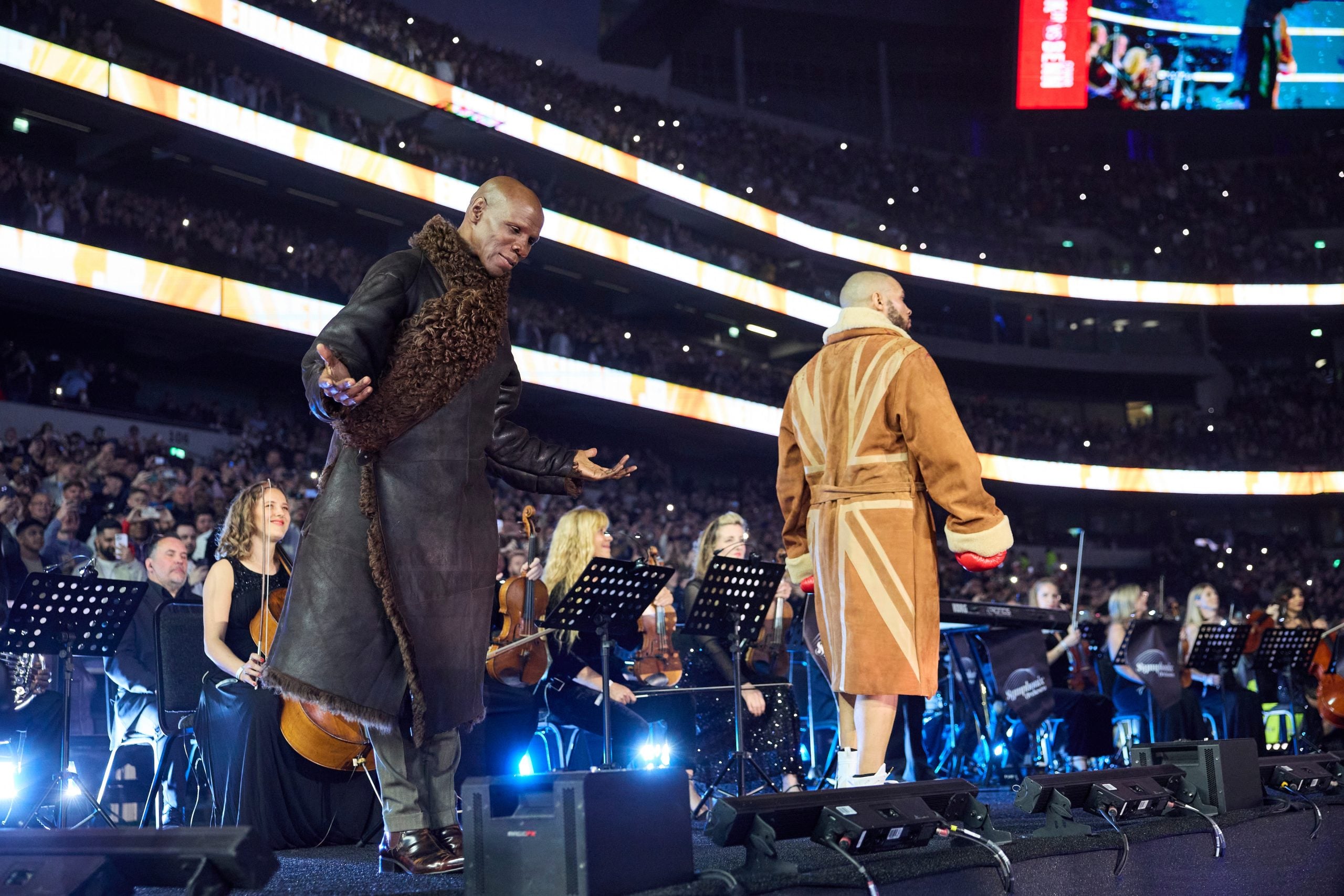
Boxing fans evidently understood the sentiment. By the time we captured it, the post had accumulated more than 134,000 views and 1,000 likes. Another post that day, offering his interpretation of Boxing’s Saudi power-broker Turki Alalshikh’s plans, had drawn almost 64,000 views.
There was an audience for Faz’s taste in clips and his take on the sport. Over the following days, his output increasingly offered another reason to follow: the suggestion that he knew what was coming next.
Around the Fury–Joshua announcement press conference, the account’s tone changed almost overnight. The shift was accompanied by an apparent rebrand from @fahazhan10 to @FazSportz.
By 1 October, Faz was offering information from inside promotional negotiations, broadcasting arrangements and fighters’ contracts. Six posts that day used the language of someone with access.
“From a source close to the talks, I can exclusively reveal,” began an update about Chris Eubank Jr and Matchroom.
“I can reveal,” he wrote about Ben Whittaker’s contractual position.
“I can exclusively reveal,” came another, this time concerning Matchroom’s requests for Joe Cordina to appear on the Fury–Joshua undercard.
Even a correction arrived as an exclusive. After floating Adam Azim against Lamont Roach Jr, Faz announced that he could “exclusively confirm” it would not happen. He had since spoken to a “highly credible source”.
His claimed reach already extended from promotional deals to undercard matchmaking and who would walk to the ring last for the biggest fight in British boxing.
The fan sharing clips and opinions was still there. But now he was presenting himself as someone who could tell you what the people in those clips were doing behind closed doors.
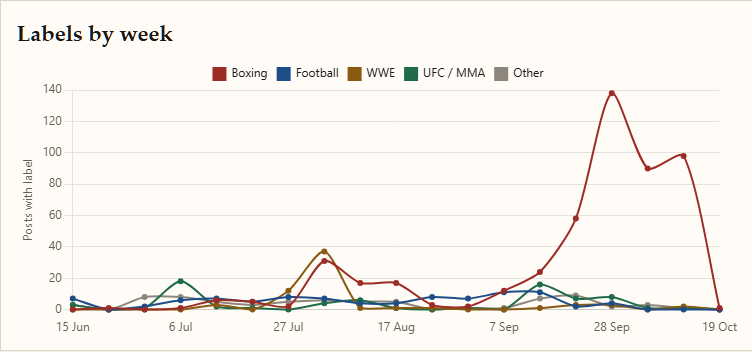
The scale of activity changed with it. Across an 18-day stretch from 30 September, the archive contains 311 posts, roughly 17 a day. Their combined view counts, recorded when collected, exceeded seven million. By our estimations, the @FazSportz account was collecting nearly 1000 new followers per week.
For sports fans, there are few things more tempting than an inside track. Who’s signing, which fight is being made, what’s holding up the announcement. Following the right account offers the satisfaction of knowing something before your mates do.
Faz was increasingly presenting himself as that account. He had moved from joining the conversation to suggesting he knew what everyone would be talking about next.
Announcing the announcements
By 7 October, Faz was announcing the announcements.
“Been sitting on this one for 48 hours… Now I have the green light,” he posted. “Chris Eubank Jr news dropping at 6:30am BST. And yes… it’s an exclusive.”
Whatever was coming, it apparently required clearance, a release time and an early start.
The wording offered its own little story. Someone had told Faz something. He had held it back. Now permission had arrived. His followers were being invited to wait with him for information the rest of boxing had yet to hear.
For anyone familiar with football’s social media transfer ecosystem, the presentation was recognisable. The account with news coming later. The unnamed contact close to negotiations. The suggestion that a deal was moving, even when an announcement wasn’t.
These are the surroundings in which the football ITK, or “in the know”, accounts operate. Supporters want to know who is coming. Clubs and agents have reasons to reveal some things and conceal others. Between the public statements sits an enormous appetite for updates.
Boxing provides plenty of room for the same approach. A fight can be discussed, negotiated, agreed in principle, awaiting a signature or waiting for someone to find the money. Fans might spend months hearing that an announcement is imminent.
An account offering to explain what is happening inside those conversations has an obvious attraction.
Faz supplied the language. “Per source.” “I’m told.” “I can confirm.” The posts increasingly placed him somewhere between the people making decisions and the audience waiting to hear them.
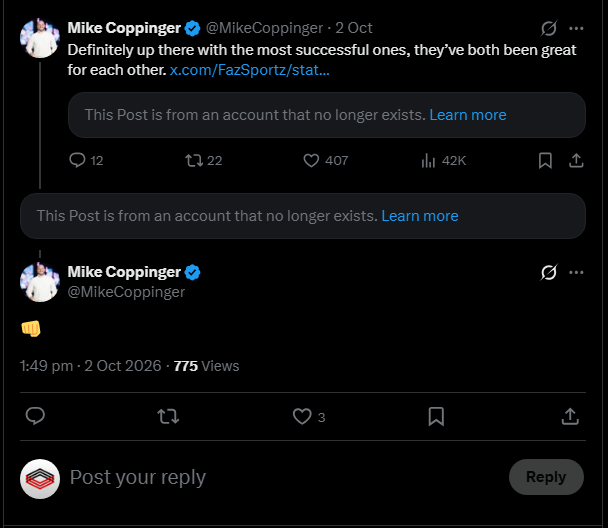
Recognisable figures were appearing around the account, too. On 5 October, a post in which Faz said he had spoken to Cris Cyborg drew the fighter and promoter Dmitriy Salita into the discussion in his replies. On 8 October, Mike Coppinger replied to Faz’s update about Devin Haney–Shakur Stevenson: “We’re in the red zone”.
A reply from an established reporter did not authenticate Faz’s sources. Nor did a promoter joining an argument establish that everything in the original post was correct. But these were real interactions with people boxing fans recognised, taking place beneath the posts of someone many had only recently encountered.
There was pushback as well. Even the much-maligned Boxing King Media publicly challenged one of his claims over Joshua’s training arrangements. Other accounts mocked or disputed circulating fight rumours. The timeline was not an uninterrupted procession of admirers.
Still, Faz had acquired the outward features of the role: an audience, a stream of updates, apparent contacts and news important enough to trail in advance.
The next question was what his sources were actually supplying.
For that, we had to go back beyond the confident introductions and look at what had been public before Faz revealed it.
The remarkable business of being right
On 12 October, Faz had a professional milestone to share. Sky Sports was reporting a story he had broken first.
“Story I broke four days ago first is now being reported by Sky Sports today regarding Claressa Shields vs Lauren Price,” he wrote, quoting his earlier post.
There was a problem with this account of events. Sky Sports had reported those negotiations almost eight weeks before Faz’s exclusive.
His original post, published on 8 October, announced that Shields was in talks for “TWO huge fights”. Lauren Price and Chantelle Cameron were the opponents, early 2027 was the proposed window, and Detroit or Atlanta could host. BOXXER and Most Valuable Promotions were named as the companies involved.
“Per Source,” Faz wrote, “I can confirm”.
It sounded like a useful collection of information from someone close to the discussions. Much of it was already available to anyone following Shields’ career.
Sky had covered the Price negotiations in August, quoting promoter Dmitriy Salita about discussions with BOXXER. It had reported advanced talks involving Cameron and MVP in September. Shields had also publicly discussed the Cameron fight and the possible locations.
Faz had brought the ingredients together. Whether a contact had supplied a fresh update was a separate question. His assertion that MVP talks had started within the previous week might have referred to a new round of discussions.
But the claim to have broken the Price story before Sky was difficult to reconcile with the broadcaster having already published it.
Four days after his post, Sky’s interview with Salita gave Faz something he could present as confirmation. Followers seeing the two posts together were offered a satisfying sequence: Faz reports, major broadcaster follows.
You had to look further back to find the less satisfying version.
Elsewhere, the distinction between knowing a fight was being discussed and knowing it was signed proved rather important.
By early October, Keyshawn Davis against Richardson Hitchins was hardly a secret. Mike Coppinger had reported advanced negotiations in September. The fighters had publicly encouraged interest. Dana White had described an appearance on the Fury–Joshua undercard as “more than likely”.
On 3 October, Faz removed the remaining uncertainty.
“Keyshawn Davis vs Richardson Hitchins is a DONE DEAL,” he announced. “The bout has been officially agreed and signed”.
He went further, attributing to a source the claim that SELA had completed the bout agreement with Top Rank and Zuffa Boxing.
Ten days later, one of the men supposedly involved in this signed fight was still looking for his contract.
“I accepted this fight over a month ago still no contract or anything official I’m still waiting for a contract and time is fucking ticking Keyshawn,” Hitchins wrote.

A fight can fall apart after an agreement. Promoters can reach understandings before every document is completed. But “officially agreed and signed” was a specific claim, and Hitchins’ account directly challenged it. By 23 October, Hitchins was saying the fight was off.
Bob Arum later confirmed that Top Rank had granted Davis’s request for release despite a fight remaining on his contract, adding another question about Faz’s account of a completed agreement involving the promoter.
These distinctions matter when assessing an insider’s record. Predicting a plausible fight, reporting negotiations and confirming signed contracts are different achievements. A fight eventually happening does not prove that someone claiming it was already signed had their facts right.
Other posts were harder to resolve.
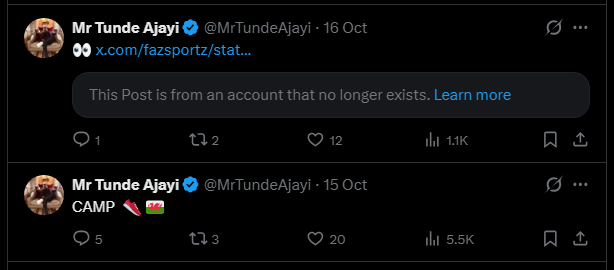
On 13 October, Faz teased a surprise addition to the Fury–Joshua undercard. Three days later, he named Anthony Yarde and linked back to the earlier post.
There was something to support the possibility. Yarde’s trainer, Tunde Ajayi, had posted a camp message with a Welsh flag shortly before Faz named the fighter. Ajayi then quote-posted Faz’s report with an eyes emoji.
That was meaningful engagement from someone who would know about Yarde’s plans. It left open the possibility of genuine information, alongside the possibility that Faz had joined some publicly available dots. Ajayi did not respond to our question about the post, sent by direct message on X.
What the earlier teaser established was less impressive. It had named nobody. Only when Yarde appeared did the old post become a prediction about Yarde.
Alongside the purported scoops, Faz also did the familiar work of a boxing news account: crediting other journalists’ reports and sharing official announcements.
That mixture made the account harder to assess. Properly attributed news sat alongside public information presented as exclusive, plausible inference, disputed claims and potentially genuine reporting. Later developments could then be held up as proof of an earlier scoop without establishing every detail that had accompanied it.
Then came a claim whose most memorable detail was impossible to overlook.
Four hundred million dollars.
Four hundred million dollars
Even by boxing’s extravagant Saudi-era standards, $400 million was a number worth stopping for.
According to the big scoop Faz used to launch his Substack on 12 October, it was the value of a three-fight offer from TKO’s Zuffa Boxing that Anthony Joshua had rejected. The story had money, loyalty and the sport’s competing promotional powers. Joshua could supposedly have taken an extraordinary payday but had chosen to remain with Matchroom.
There was a familiar echo beneath the extraordinary figure. On 6 October, Joshua’s promoter Eddie Hearn had said his fighter rejected a separate TKO proposal worth around $10 million, involving moving the Fury fight to America and allowing TKO to promote it. Joshua turning down TKO money was already a story. A $400 million, three-fight offer was quite another.
Quite why a publicly traded company like TKO would offer roughly 10% of its annual revenue to a fighter whose biggest commercial payday against Fury would soon be behind him, at $133 million per bout, seemed to escape Faz’s analysis. The apparent scaling back of Saudi financing made the figure all the more remarkable.
However you look at it, it was a substantial development for a newly established insider to uncover.
Faz published the claim on his newly created Substack and promoted it on X. His reporting now had somewhere to live beyond the timeline, under a headline promising an exclusive account of the proposed deal.
Other accounts picked it up.
The same day, news aggregator IFN repeated the $400 million, three-fight proposition, explicitly crediting FazSportz. The post described Joshua as having immediately rejected the offer and remained loyal to Matchroom. Money, astonishment and flame emojis accompanied the news.
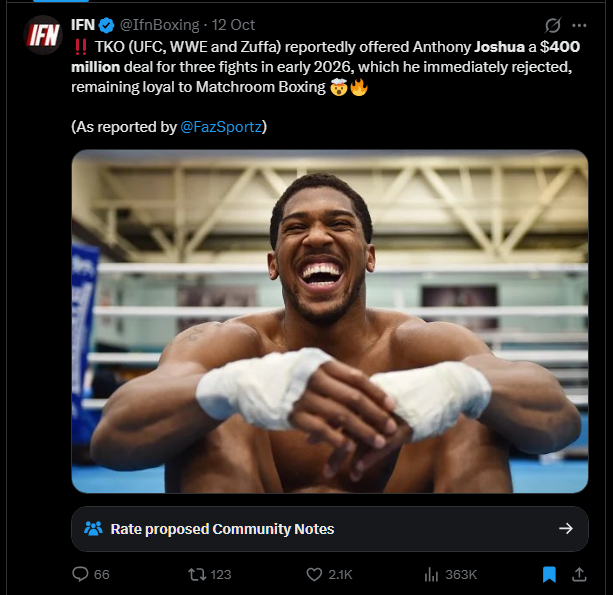
A follow-up supplied a qualification.
“IFN cannot attest to the reliability of these reports.”
There was an unusual division of labour here. One post delivered the extraordinary claim. Another explained that the account passing it on could not vouch for it.
The main post had accumulated more than 363,000 views at the time of publishing.
The following day, Pro Boxing Fans repeated the proposition, again naming Faz as its source. Its post used “reportedly”, but the essentials remained: three fights, $400 million, Joshua choosing Matchroom.
The claim now appeared under several publishers’ names. Following the credits back, however, brought readers to the same account.
That distinction is easy to lose while scrolling. Seeing a story repeatedly can make it feel increasingly established, even when the repetitions add no further confirmation.
By 21 October, the $400 million claim had reached a conversation between IFL TV’s Kugan Cassius and Joshua’s promoter, Eddie Hearn.
Cassius said he had forwarded Hearn an Instagram report about Joshua turning down the money. Hearn remembered both the story and its qualification that the facts had not been confirmed.
“Quite a few people sent me that,” he said.
His answer to Cassius had been straightforward: “No, wasn’t true.”
“It’s unbelievable some of the things you read,” Hearn said. “But you know, that’s boxing.”
The claim had reached Joshua’s promoter. Along the way, accounts repeating it had introduced their audiences to FazSportz.
On 12 October, as his purported exclusive circulated, he posted a defence of his place in boxing media that received over 85 likes and 18 supportive replies.
“Break a story before them and you’re met with claims it’s lies or private DMs with abuse,” he wrote, attributing some of that hostility to established journalists without naming them.
He presented the criticism as resentment at being beaten to a story.
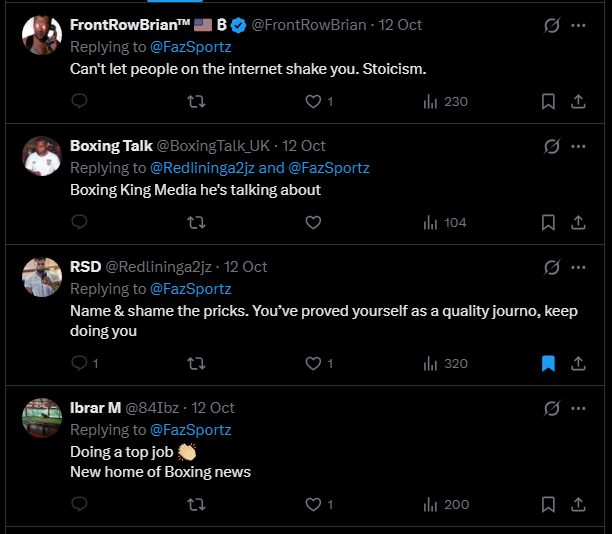
“I’m here to do my job, build FazSportz and let the stories speak for themselves. There should be room for everyone.”
The post did not identify which stories or exchanges he meant. But his description of what he wanted was clear.
“It’s genuinely disheartening when all I’m trying to do is build my name and brand in a sport I love.”
The $400 million claim had certainly helped get that name into wider circulation. Whether it stood up was another matter.
And in boxing, getting your name known can open doors.
Becoming someone in boxing
There is an obvious attraction to becoming someone in a sport you love.
The people you have spent years watching begin replying. Other accounts quote you. Your name appears beneath a story strangers pass around. An opinion that once would have disappeared into the timeline now sparks an argument involving people who actually make the fights.
An audience can also have practical value. Publishers need people who can reach readers. Promoters need attention. Commercial partners want access to followers. A boxing account can become a portfolio, a business or an introduction.
Michael Benson offers perhaps the clearest illustration of what an established audience can be worth.
Starting as a junior sports reporter at talkSPORT and later becoming its boxing editor, Benson built a substantial following by sharing a steady stream of news, quotes, and clips. For followers, the account offered a convenient way to keep up with a sport whose information is scattered across interviews, broadcasts and other people’s timelines.
As Turki Al-Sheikh took over The Ring, Benson joined to run its social media and sold the publication his X account, which was rebranded under The Ring’s name. Al-Sheikh acquired both the man and a ready-made audience.
Darshan Desai provides another route.
Boxing followers knew him as EverythingBoxing. His work also appeared under his own name at fan-run site NoSmokeSport. He now reports for Yahoo Sports and Uncrowned, whose author biography directs readers to the same @EverythingBoxi2 account.
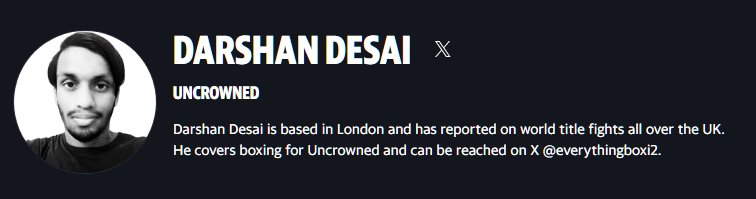
The social identity and the professional byline sit alongside one another. An account fans use to find boxing news can also become where a working reporter publishes it.
And the opportunities extend beyond media.
Rian Scalia was a cult figure on Boxing Twitter, with a background in writing, podcasting and scouting. He later worked with ProBox before moving into Zuffa’s matchmaking operation.
Here was another destination for someone known within boxing’s online community. His knowledge of fighters could help put the bouts together, rather than simply tell followers when they had been announced.
These careers involved work beyond maintaining a popular timeline. But they demonstrate that the opportunities are real.
There is value in gathering other people’s reporting, too. Few fans have time to watch every interview, follow every promoter, and track every proposed fight. Someone who does that work and tells readers where the information came from provides a useful service.
Andrew, who posts as @ATokkers5, runs a popular, well-established account on Boxing Twitter alongside a career outside the sport. His timeline carries the familiar names and aggregated breaking stories, but also reflects years spent following international prospects, amateur fighters and young boxers whose careers have barely begun.
In our conversation for the piece, he described this more specialist coverage as attracting limited engagement. The audience for a major fight announcement does not necessarily follow him into boxing’s less fashionable corners. He knows what draws attention. He also chooses to cover what doesn’t.
He also offered a less glamorous account of his access to the industry. Despite his established audience and years of involvement, he considered his influence relatively limited and the trust he had built with sources modest.
That was familiar to us. Box.Live has been around for roughly a decade. A routine request for comment can still disappear into an inbox without troubling anyone’s afternoon.
None of that means a newcomer cannot receive a genuine tip. But it helps explain why the breadth of Faz’s claimed access deserved scrutiny. Within a short period, he was presenting information about fighters’ contracts, promotional discussions, broadcasting decisions and government funding.
His public persona seemed to have skipped several of the less rewarding stages of becoming a boxing reporter.
What he hoped to get from it is harder to establish. Recognition, work and money are possible incentives in this world. Their availability does not tell us which mattered to him.
We can trace the change in what he offered his audience. First came opinions and clips. Then came information supposedly obtained from people inside the sport.
Eventually, there was an offer followers could accept for themselves.
Two floor seats to a heavyweight title fight.
Faz’s contacts
Who was in Faz’s phone?
A useful boxing contact might tell you when a fighter is coming back. Faz’s apparent network could also explain Netflix’s approval process, government funding decisions and where Eddie Hearn might be having a meeting.
The range was impressive.
Across 94 archived posts, we grouped his reporting into 40 sets of claims, covering 51 fighter subjects and proposed opponents. The stories stretched across nine countries, from training arrangements in Spain and a team member in Japan to a possible heavyweight homecoming in Croatia.
His apparent briefing sheet looked something like this:
| Department | What Faz claimed to know |
|---|---|
| Fighter relations | Benn’s comeback plans, Inoue’s featherweight ambitions and Team Lopez’s position on a WBA appeal. |
| Television | Netflix’s approval for Opetaia–Wilder and discussions involving Pacquiao |
| Human resources | Production staff’s concerns about travelling to Riyadh |
| Government affairs | Whether Victoria would fund Eubank–Zerafa, and Queensberry’s talks with Croatia |
| Finance | Promoter advance payments and whether Canelo would still be paid if his event was cancelled |
| Testing and medical | When Fury’s drug testing began, plus an unnamed fighter’s possible hand injury |
| Conference arrangements | Who would chair a proposed Hearn–Dana White meeting, with the Waldorf Astoria identified as its expected venue |
There were sources close to teams, sources close to situations and, when one Azim rumour needed correcting, a “highly credible source” with knowledge of his next opponent. Production staff came in the plural.
These figures do not amount to 51 camp contacts or a source in nine countries. One well-connected intermediary could know about several negotiations. Some interviews may have been genuine. Much of the information we examined was already public.
That was part of the problem. Information another reporter had already published could reappear beneath an assurance that Faz had heard it from a source. The language of access made familiar news sound freshly delivered.
Still, the breadth of the claimed knowledge was striking. Comeback plans, government funding, staff concerns… and a hotel venue for Hearn and White’s big peace talks.
By the time the Waldorf Astoria entered the conversation, a boxing insider from Burton upon Trent apparently had the inside track on meeting rooms being booked in Beverly Hills.
Back to the giveaway
For someone who had just won two floor seats to a heavyweight title fight, Josh had made surprisingly little noise about it.
Another entrant, boxing fan Rhys Aldous, had noticed something else. The winning account was only days old.
On Friday evening, he publicly accused Faz of selecting his own burner account to win the competition. Shortly afterwards, the giveaway posts and winner announcement disappeared.
By Saturday, the day of Dubois–Wardley II, Box.Live had publicly challenged Faz to explain the giveaway on behalf of those who had entered.
We asked him publicly for his side of the story, then emailed questions about the tickets, the draw and the winner. If there was a straightforward explanation, we offered to publish it.
Faz did not answer.
The winner, however, suddenly had plenty to say.
Posts on @JoshSingh777’s timeline presented a boxing fan on his way to the O2. In replies to our post questioning Faz, he insisted that he had won the tickets and that Faz had contacted him to arrange everything.
“I had no issues receiving the tickets so this is misleading from yourselves.”
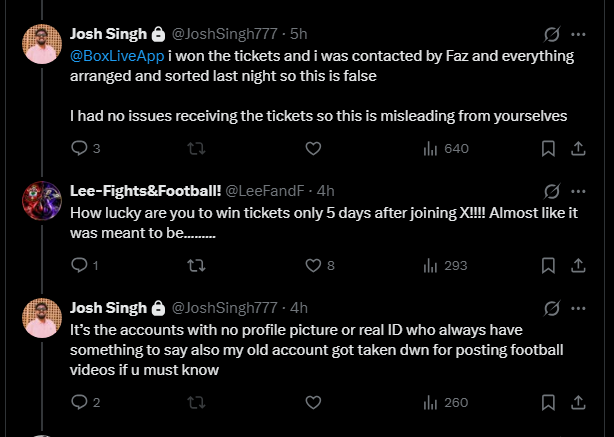
The tone soon became less friendly.
“Just About to enter the O2 and I got sent this post you miserable human,” he wrote, before attacking other accounts for questioning how recently his profile had been created.
Here was someone claiming to have exactly the evidence that could settle the matter. We spotted some of his replies in our spam comments and invited him to DM us.
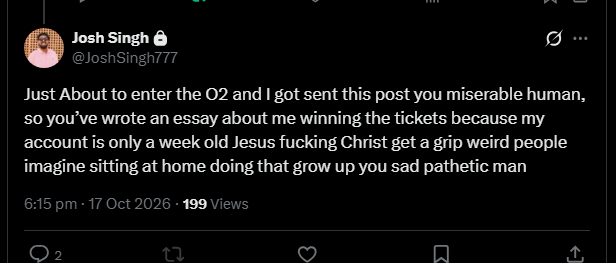
What arrived did little to establish where the tickets had gone.
Even before we had interacted with Josh, he had supplied another explanation for our interest.
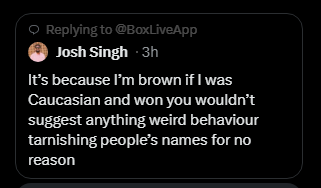
“It’s because I’m brown, if I was Caucasian and won you wouldn’t suggest anything”.
Our concerns had begun before we knew anything about the supposed winner’s ethnicity. We pointed out that the only original clue to his identity had been the name Josh, hardly a basis for the assumption he was alleging.
This did not improve the conversation.
Josh appeared to read our explanation as a fresh attack on his ethnicity and surname.
“RACIST!”
A lengthy DM followed, accusing us of tarnishing his name and insisting he had won fairly. Then came a shorter message.
“You’re a horrible horrible racist”.
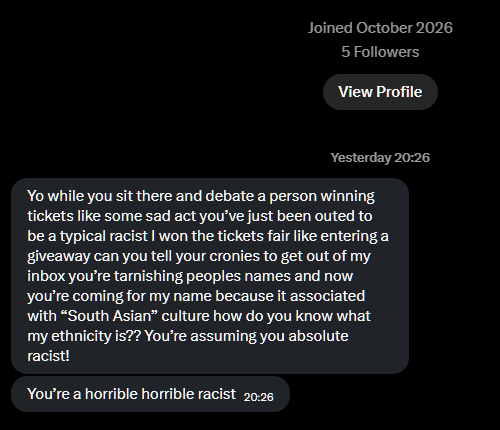
The competition now had a winner who claimed to be attending the event, disputed our reporting and had found time for an argument about ethnicity. What he had not supplied was anything confirming the tickets.
All this was supposedly being sent from the O2, where Josh had two free floor seats and a busy undercard competing for his attention.
By Sunday morning, Faz had removed his profile photograph and Josh had locked his account.
Faz had also finally replied to our email.
“This is a formal warning.”
He accused us of making false allegations, said he was involving his solicitor and demanded that we stop damaging his reputation.
There were no answers about the draw. No explanation for deleting the posts. No evidence of the tickets.

Meanwhile, Tom from UK Fight Nights traced Josh’s profile picture to an apparent source: a photograph of a Canadian real estate agent with the same name.
The competition winner appeared to have borrowed someone else’s identity.
That did not establish who was operating the account. It did make his claims to be a genuine competition winner even harder to take at face value.
We asked Faz to identify anything inaccurate and repeated our offer to publish a clarification supported by evidence.
By Sunday afternoon, as the giveaway attracted more attention on X, both Josh’s account and the main FazSportz account had disappeared.
Two floor seats had been advertised, a winner announced, and the competition posts erased. Now both accounts were gone. The only response from the man running the giveaway was a legal warning.
Faz remained off X for roughly three days. On Wednesday evening, he reactivated his account and posted a statement explaining the giveaway. He also returned to our inbox with a different approach.
He wanted to apologise and have a “gentleman’s conversation” over the phone.
We welcomed an explanation but asked to establish the facts in writing.
His email explanation introduced an Instagram page.
According to Faz, it had noticed the views his boxing posts were attracting and offered future sponsorship if he could demonstrate he could bring people into a competition.
The page had also created the winning account.
“I was told to just send a tweet out and announce that account as the winner to which I did.”
He said he had received no money and had been “led down the garden path”. When the controversy erupted, the Instagram page had disappeared.
We asked who had approached him and whether he had the messages.
“BoxGiveaways or something similar,” he replied.
He had no screenshots.
And the tickets?
“There was no tickets at all”.
He said he had assumed they existed and had asked for no evidence.
“I just thought it was cool”.
The winner had spent Saturday defending the receipt of a prize that, by the competition organiser’s own subsequent account, had never existed.
Faz maintained that he, too, had been deceived. We had no records with which to test his account of the Instagram arrangement, and his explanation still left a basic question unresolved.
When had he understood that the account he was announcing belonged to the people supplying the supposed prize?
On X, his statement offered a less explicit account. It described the sponsorship proposal, denied taking money and said the winning account was associated with the Instagram page. It did not tell entrants that there had been no tickets.
It did, however, defend his boxing work.
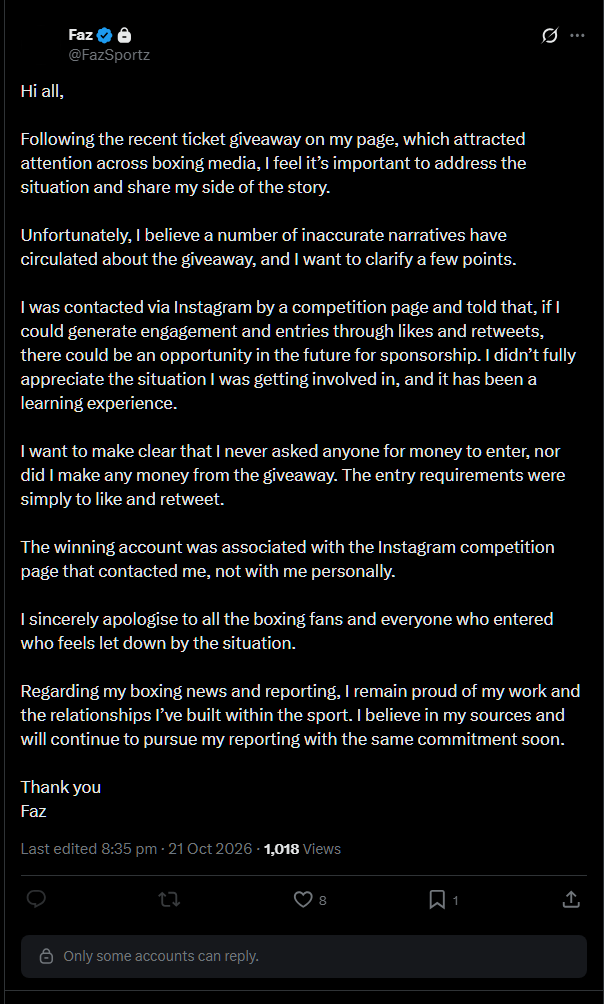
“I remain proud of my work and the relationships I’ve built within the sport. I believe in my sources”.
By then, other people had been getting in touch.
They had spoken to him privately, away from the exclusives and the familiar names in his replies. They had messages and voice notes to share.
One conversation offered a rather different explanation for where the giveaway tickets had come from.
It also brought us back to the question behind his brief career as a boxing insider.
Who, exactly, did he know?
Matt at Queensberry
Before our mystery man, Josh, won the tickets and disappeared, another entrant ran into a complication with the giveaway’s rules. She couldn’t publicly name the person she wanted to take.
Faz moved the conversation into her DMs.
The woman, who promotes adult content she creates via her X account, told him about a private connection involving boxing. She has asked not to be identified, and we are withholding the details of that connection.
Faz appeared to have a way of helping. There might be more tickets available, beyond the pair being given away publicly.
He sent a voice note explaining that he had applied too late for media accreditation, but had a contact at the promoter.
“Matt is my contact,” he said.
“He’s giving me two tickets to give away as I’m now part of their media moving forward and I can go to their Queensbury events … as media.”
The arrangement, as he described it, explained both the giveaway and his apparent access to future events.
“That’s why I’m giving two floor tickets away.”
He said he had already emailed Matt to ask for another pair for her, describing the request in his voice note.
“Matt, you couldn’t throw me two more tickets, please, mate, to give to someone?”
He had even supplied a reason for the favour.
“I just made out like it’s family.”
He hoped Matt would reply by the following day with confirmation that another two tickets were available.
The conversation moved to WhatsApp. According to the screenshots the woman provided, his questions turned to her relationship status and how a relationship would work alongside her adult-content work.
She told Box.Live she was not interested in him. She was keeping the conversation friendly because she wanted access to the tickets.
The voice note gave her a reason to believe that access existed. It also gave us a specific account to check.
Who was Matt, and what had he actually offered Faz?
A separate source working around boxing media supplied part of the answer.
He told Box.Live that he and Faz had started chatting over private messages on 10 October when Faz asked him for basic Queensberry media contact information. This was the same period in which Faz was publicly presenting himself as someone with sources across the sport.
In their conversation, Faz claimed he previously worked for BoxNation and TNT Sports.
For our source, the request raised an obvious question. How did someone claiming that work background, and now offering such an extensive inside track, need help finding someone to email at Queensberry?
BoxNation was built around Frank Warren’s shows, with his son George serving as CEO of both the channel and Queensberry. Queensberry then anchored BT Sport’s boxing coverage, later TNT Sports, for roughly eight years before moving to DAZN in 2025. These were hardly obscure connections for someone claiming to have worked for both broadcasters.
The source helped. He supplied an email address for Matt Rich.
Unfortunately, it was out of date.
Rich had already left Queensberry some time ago.
This was the Matt who, in Faz’s voice note, was “my contact”.
We asked Faz to explain the arrangement and whether either pair of tickets had ever been supplied.
“I am very embarrassed by the… question,” he replied.
He confirmed that another boxing account had supplied Matt’s address so he could request access to a media mailing list, “which I emailed and had no reply”.
As for the additional tickets, his explanation was more personal.
“I then said to a girl to impress her, I guess, that I could get her tickets,” he wrote.
He said he had thought he could ask the supposed Instagram page for more.
“I never asked them in the end.”
There was no relationship with Matt supplying tickets, no confirmed accreditation and no request for another pair. There was an unanswered enquiry about a mailing list, turned into a story about a helpful contact at Queensberry.
Whatever the Instagram page’s role in the giveaway, that story was Faz’s.
Our enquiries had also uncovered questions about his day job. The career he had described privately, involving broadcasters and major sporting organisations, looked considerably grander than the working life our open-source research had revealed.
We asked him to explain the differences and substantiate his claims.
Less than six minutes later, he replied, saying he was leaving Twitter.
“Once again I’ve received abuse and racial slurs after putting my post out.”
We offered to examine the messages and investigate any racist abuse separately. He supplied none. His account was protected on his return, with replies restricted. We saw no public abuse, but that could not rule out abusive private messages.
But we had already seen Josh’s account divert questions about the tickets into baseless accusations of racism. Now Faz was citing abuse as he withdrew from questions about his career.
He had returned declaring confidence in his reporting, relationships and sources. When asked to substantiate the background behind them, he announced his departure. Those questions remained unanswered as he again deactivated his account.
In less than a month, Faz had gone from boxing fan to self-proclaimed insider to an account that no longer existed.
But the audience he had attracted was real. So was the attention from people already established in the sport.
One uncomfortable question had nagged at me throughout the investigation: if the giveaway had not unravelled, how much longer would Faz have needed before being treated as an established boxing insider?
An End Game
The uncomfortable possibility is that, given enough time, Faz might have turned the role he was playing into a real one.
An account with an audience can become useful to people inside boxing. Someone wants a story circulated, a possible opponent mentioned or a particular version of negotiations put into the public domain. A message arrives. Then another. The person who once announced that he had sources might finally acquire some.
The performance of access could produce actual access. Would becoming more trustworthy have been a condition of that progress?
Michael Benson’s career illustrates the value of the audience, although his route was plainly different. As we have seen, his popular account eventually became part of The Ring’s operation. Gathering boxing’s scattered news, interviews and arguments into one busy timeline helped build something an established publisher wanted.
But the way he began building that audience had ethical issues too, and deserves scrutiny.
In his early years as an aggregator, Benson repeatedly shared information from other people’s reporting without linking to the articles or videos it came from, or even acknowledging their social handles. Followers received the news. The people whose work supplied it could disappear from the transaction.
I was among those who publicly challenged him over the practice, rounding on him one night alongside Will Kent, then of ESPN UK, and Danny Flexen of SecondsOut.
Benson subsequently issued a statement. He explained that links made his tweets look messy and admitted resisting requests to include them.
“From a petty point of view I just didn’t want to give them what they wanted to be totally honest.”
He begrudgingly committed to more tagging, occasional links and adding credits when omissions were raised.
That was an improvement. It did not end the complaints about how much recognition and traffic reached the people doing the original work.
When the summary travels further than the original, the person collecting the reporting can become more recognisable than the people producing it. Readers learn whose account to check. They may never learn whose hard-earned relationships and phone calls made the story possible.
In a sport with a shrinking pool of professional journalists equipped to hold its bad actors accountable, the consequences of aggregation go beyond who gets their share of the attention.
Yet disputes about misinformation and attribution occupy a fairly modest corner of boxing’s problems.
This is a sport repeatedly confronted with doping controversies, domestic abuse and the involvement of people linked to organised crime.
The ownership histories of two of its most prominent media outlets offer little reassurance. BoxingScene was bought by Garry Jonas, who settled US federal allegations involving deceptive marketing and unauthorised charges on consumers’ phone bills. The Ring was acquired by Saudi royal adviser Turki Al-Sheikh, whose alleged involvement in the intimidation and detention of critics was examined by The Athletic. He later dismissed the report as fictitious.
Al-Sheikh also serves a government that, according to Amnesty International, imprisons peaceful critics and executes people following grossly unfair trials.
Boxing’s capacity to accommodate useful people with uncomfortable histories is considerable.
Against that background, how surprising would it be if someone like Faz concluded that a few invented sources might not prove much of an obstacle to entry?
That does not tell us what Faz thought. It does make the environment worth examining. An audience can become valuable before anyone has established whether its owner deserves to be believed. Once that audience becomes useful to people inside the sport, scrutiny can become inconvenient.
Faz had dabbled in making content on YouTube and later launched a Substack. He was actively exploring a place in boxing media, whatever else he hoped to gain.
You can imagine a version of this story in which the giveaway never happened. The account kept growing. More people replied. Genuine information began arriving among the claims. Eventually, he could point to real contacts as evidence that he had been an insider all along.
Would anyone have gone back to check the earlier stories?
In our conversation, Andrew’s (@ATokkers5) assessment was blunter. He doubted Faz had much of a plan, or the knowledge and judgment to keep the performance going for long.
Then there are the incentives of social media. A claim attracts attention. The next one is bigger. Established accounts engage. The numbers rise. Whatever doubts might have interrupted Faz’s performance now compete with the visible reward for continuing it.
We cannot establish what the algorithm caused. But it could have rewarded him for repeating and escalating the very behaviour that would eventually expose him.
That explanation deserves consideration.
So does the possibility that it gives his newfound attention too much credit.
After the giveaway, writer Craig Scott stepped forward with his own memory of Faz the fan, three years earlier.
Following Chris Billam-Smith’s victory over Lawrence Okolie in May 2023, Scott had responded to something Faz posted with a fairly innocuous jab. According to Scott’s account, Faz returned with insults about his appearance and threats of violence towards him and his mother.
Faz later told us he had apologised to Scott and his mother. He could not recall the original back-and-forth, but acknowledged that his behaviour was inexcusable.
Then there was the earlier ticket episode, just days before he assumed the insider role.
Faz had offered his unused tickets to the Fury–Joshua launch press conference in London, presenting himself as someone who could help people out.
These tickets did exist. He supplied an AXS confirmation to Box.Live concerning their transfer to a personal friend.
But another woman told us she had also been offered them. According to her account, Faz said he was uncomfortable providing the ticket-account details through X and insisted that she add him on WhatsApp instead.
Once there, he supplied login details. She found no tickets.
As with the woman from the later giveaway, she said the conversation turned towards her relationship status. Despite rejecting his advances, she said he persisted in trying to meet her offline before she blocked him.
Perhaps the attention encouraged him to behave differently. Perhaps it gave existing behaviour a much larger audience. Neither explanation removes his responsibility for what he told people.
The women offered tickets were dealing with something more immediate than a debate about media standards. They were deciding whom to trust, what to share and whether to continue a private conversation. His claims of access and the popularity of his posts helped shape those decisions.
That is where the supposed insider’s performance acquired consequences beyond the timeline.
Faz’s giveaway unravelled. The tickets did not exist. His story about a helpful Queensberry contact collapsed into an unanswered request to join a press-release mailing list, the first rung on the media ladder. Asked to substantiate his wider professional background, he left the questions unanswered and disappeared.
But the incentives that made the performance attractive remain. In boxing, attention and money can open doors long before anyone asks how either was acquired.
The next Faz might get further. Boxing has never demanded a spotless past, just a useful future.







Give us your thoughts on Was any of it real? The rise and fall of boxing “insider” FazSportz
Please login to comment
log in